
Latest update April 21, 2026
[cg_add-class=heading-style-h4]In a Nutshell
- An environmental management system in accordance with ISO 14001 helps companies to systematically manage environmental aspects and reliably meet legal requirements
- The ISO standard promotes transparency, improves environmental performance, and strengthens the company's position with customers, partners, and ESG ratings
- 51ºÚÁÏ digitizes and structures the entire ISO 14001 process—from data collection and internal audits to documentation
- The standard was updated in April 2026. Organizations with an existing ISO 14001 certification must align with the new edition by May 2029.
- With AI-supported assistance, companies save time, avoid errors, and are always ready for audits
NOTE:Â The ISO 14001 standard has been updated.
The first major update in over a decade was published on 15 April 2026. It strengthens requirements around climate change, biodiversity, lifecycle thinking, and supply chain controls. Organizations with an existing certification have until May 2029 to update. For a full breakdown of what changed and a practical checklist, read our guide:
If you want to take on long-term responsibility as a sustainability manager, there is no getting around a certified environmental management system (EMS) in accordance with ISO 14001. But what exactly is behind the DIN EN ISO 14001 standard? What does it specifically require? And how can you make implementation efficient and audit-proof, ideally with software support?
In this blog article, we provide a clear overview of the content and benefits of ISO 14001, typical challenges during implementation, and practical ways to prepare internal audits, checklists, and documentation in a targeted manner. We also show how an AI-supported solution such as 51ºÚÁÏ helps save time, keep data consistent, and prepare confidently for external audits.
Why ISO 14001 is More Than Just an Environmental Certificate
ISO 14001 is the globally recognized standard for environmental management systems. Companies that obtain certification commit not only to environmental compliance, but also to continuously improving their environmental performance. The aim is to make measurable contributions to environmental protection, for example through resource conservation, emission avoidance, or systematic risk analysis.
A valid environmental certificate according to ISO 14001 signals to customers, authorities, and stakeholders that sustainability is not merely communicated within the company, but actively managed. It strengthens the company's position in tenders, creates transparency, and at the same time reduces liability risks. With the latest edition (published April 2026), the standard places even stronger emphasis on climate resilience, biodiversity, and lifecycle thinking, reinforcing its role as a strategic management tool for any certified organization.
What the ISO 14001 Standard Really Requires – Explained Simply
ISO 14001 is based on the proven Plan-Do-Check-Act (PDCA) cycle. Essentially, it involves systematically recording environmental aspects, complying with legal obligations, and assessing relevant risks in order to formulate specific environmental objectives on this basis.
The latest version, ISO 14001:2026 (replacing ISO 14001:2015), retains this core structure while strengthening several requirements. Organizations must record stakeholder interests, formulate an environmental policy, present a risk analysis with a lifecycle perspective, and keep records of training, communication, responsibilities, and audits.
The most important sections at a glance:

What the Latest Edition Adds to ISO 14001 Implementation
The latest edition introduces several targeted updates that affect how organizations implement and maintain their environmental management system:
- Clause 4 (Context): Environmental conditions including climate change, pollution, biodiversity, and resource availability must now be explicitly considered. The EMS scope must reflect a lifecycle perspective.
- Clause 5 (Leadership): Top management responsibility extends beyond management roles to all relevant functions.
- Clause 6 (Planning): A new Clause 6.3 requires formal change management for EMS-related changes. Emergency situations are separated from abnormal operations.
- Clause 8 (Operations): "Outsourced processes" becomes "externally provided processes, products, or services." Operational controls must extend to suppliers and partners.�
- Clause 9 (Performance): Internal audits must define objectives. Management review is restructured into three sub-clauses: inputs, process, and results.
Many companies use an ISO 14001 checklist to systematically record the requirements. However, paper lists and Excel quickly reach their limits, especially when preparing for audits.
The Path to 14001 Environmental Certification: How to Bring Structure to Your System
Whether you are a manufacturing company or a service provider, the path to certification of an environmental management system according to DIN EN ISO 14001 usually follows a similar pattern:
- Analysis of the current situation & gap assessment
- Setup of the system (documentation, processes, roles)
- Internal environmental audit
- Preparation and implementation of the external audit
- Continuous improvement in ongoing system operation
Typical hurdles include scattered documents, missing evidence, no central overview of legal obligations, and above all: lack of time.
Those who recognize these challenges early on can take targeted countermeasures. The internal audit in particular deserves special attention. This part is not only mandatory, but also a dress rehearsal for the external audit.
Internal Audit, External Audit – and How to Prepare Yourself Optimally
A professionally prepared environmental audit in accordance with ISO 14001 not only reveals weaknesses, but also provides certainty for external audits by certification bodies. This requires clear checklists, structured documentation, and systematic comparison with the requirements of the 14001 standard.
However, checklists alone are rarely sufficient. Companies also need:
- a complete environmental impact assessment,
- an up-to-date environmental law register,
- evidence of communication and training,
- documented target tracking,
- and audit-proof versioning of all measures
- and, under ISO 14001:2026, defined audit objectives for every internal audit (not just scope and criteria).
This is precisely where the added value of digital support comes into play – for example, with 51ºÚÁÏ.
How 51ºÚÁÏ Makes Your Environmental Management System Smarter
Many sustainability managers juggle Excel, PowerPoint, PDFs, and email. This is not only stressful, but also time-consuming and jeopardizes traceability. 51ºÚÁÏ takes a different approach: the AI software structures all content in line with the requirements of ISO 14001, EMAS, and other standards.
With 51ºÚÁÏ, you can:
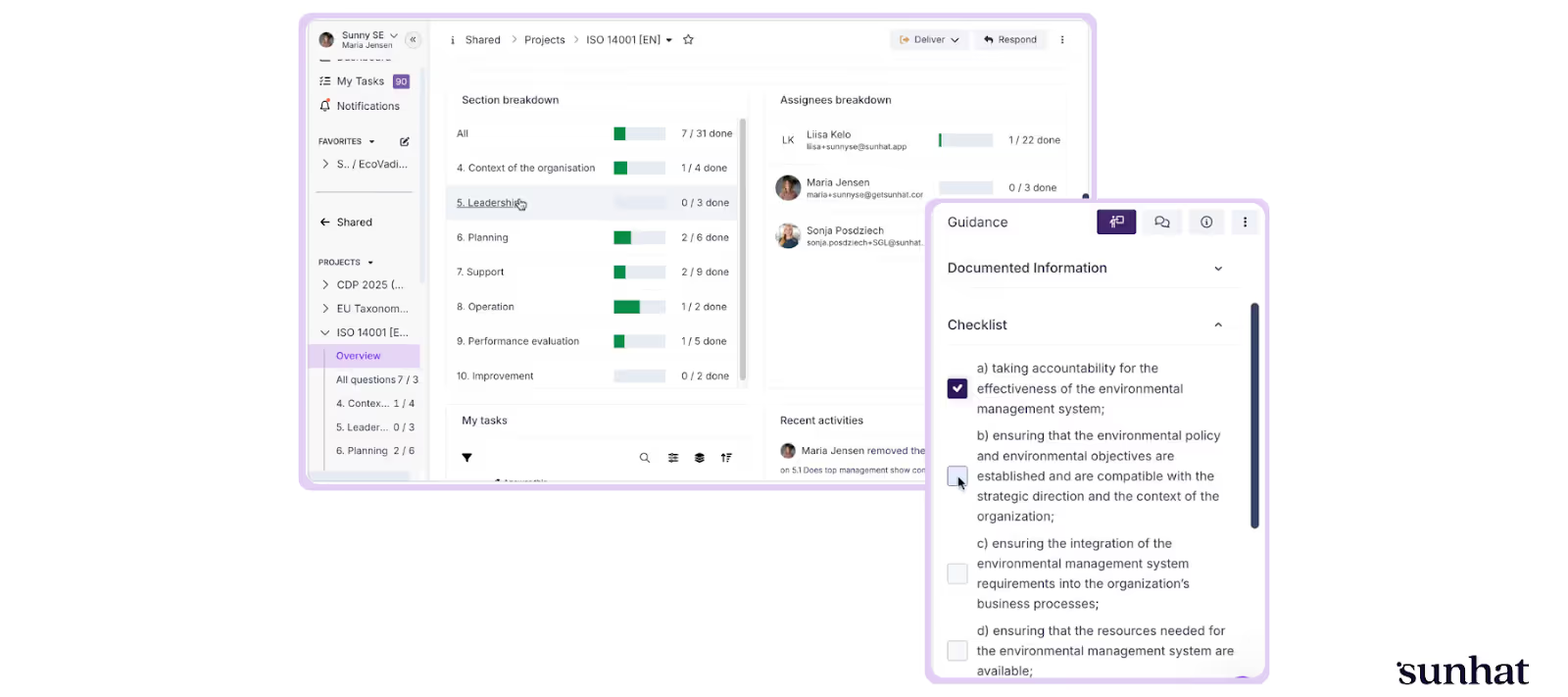
- digitally map all requirements of DIN EN ISO 14001,
- centrally manage environmental aspects, goals, and legal obligations,
- prepare for internal audits with an automated ISO 14001 checklist,
- link tasks to responsibilities (RACI), and
- structure all documents in a versioned manner.
Particularly helpful: The software enables systematic audit preparation, supports risk assessments based on environmental aspects, and allows reports or CDP responses to be generated consistently from existing content.
51ºÚÁÏ not only reduces the effort involved, but also improves quality. Sustainability managers receive a robust, verifiable system that can be continuously improved.
Environmental Management with Vision: From ISO Certification to Sustainability Strategy
An environmental management system in accordance with ISO 14001 is not just a mandatory requirement. When implemented correctly, it becomes a driver for an effective sustainability strategy. Companies that take their environmental goals seriously create structures that have an impact far beyond the certificate – for example, in ESG ratings such as EcoVadis or CDP.
Clear processes, a sound database, and reliable software support create an integrated system that is transparent, efficient, and future-proof.
With the updated standard now published, this is the ideal moment to review your environmental management system implementation against the new requirements and prepare for your next certification audit.
ISO 14001 is more than just compliance with standards – it is a lever for targeted environmental management. With the right tools, a clear structure, and good preparation, you can not only pass audits but also achieve real progress.
Stop scrambling. Start proving.
Your next customer questionnaire, assessment, or audit doesn't have to be a fire drill. Get the platform that keeps proof ready for every request.

Frequently Asked Questions
No, but certification provides a structured framework for systematically managing and credibly documenting environmental aspects. For many customers and investors, this is an important signal – especially in the context of growing ESG requirements.
The costs depend on the size of the company, its complexity, and the certification body. It is significantly cheaper if processes are digitized and internal audits are well prepared – for example, with software such as 51ºÚÁÏ, which noticeably reduces the effort per audit cycle.
The standard is compatible with other standards such as ISO 9001 (quality) or ISO 50001 (energy). The High Level Structure (HLS) allows synergies to be exploited – e.g. in risk analyses, audits or documentation. This saves resources and promotes integrated management.


.avif)